While the Friends broadly welcome the development of a Foreshore Master Plan – the removal of cars from the Bay Run and improvements to the Bay Run are long overdue – we have major concerns with some of its key provisions.
Executive summary
The measures in the Draft Master Plan to protect Callan Point are insufficient and we support the urgent strengthening of the protections of native flora and First Nations sites. Sadly some of the Draft Master Plan proposals for this key Harbour landmark will further degrade its environmental and heritage values. The proposals for not one, but two, additional amenities blocks on and adjacent to Callan Point are excessive and unnecessary. The maintenance of the dog beach, and better provision of access, are needed, rather than the impractical alternative in the Draft Master Plan of a new dog swimming spot adjacent to the tidal pool.
The vague proposal for an eyesore building on the absolute waterfront in the vicinity of the tidal pool is a major concern. At present the Callan Park (Special Provisions) Act 2002 bars such a development on the foreshore. The state government and the GSP are currently proposing that parliament remove this protection from the Act, however this has not yet passed both houses of parliament.
The “temporary” car park for up to 70 cars on Supply Road on the footprint of the to-be-demolished Linen Stores is another feature opposed by the Friends. This is in the centre of the parklands and in the area where nine buildings are proposed to be demolished, supposedly to increase green open space. Instead, the Draft Master Plan proposes a major car park. It is supposed to be temporary until funding becomes available for the Wharf Road car park, yet the GSP admits that government funding for Callan Park will remain constrained in the immediate future.
This constrained state government funding is a major concern despite an assurance, for instance, from the Minister for Heritage that funding for the Wharf Road car park would be forthcoming this year. We note too that insufficient funding will mean that the renovation of Repat B will be incomplete and the community section will not be renovated.
The lack of guaranteed funding will undermine the implementation of even the better features of the Master Plan. We note, for instance, that reduced funding means that much of the Bay Run though Callan Park will not provide safely separated paths for pedestrians and bikes.
We are certain the community will actively support all efforts by Greater Sydney Parklands to secure adequate funding for the environmental and heritage improvements so necessary in Callan Park.
What follows are more detailed responses.
Callan Point
Aboriginal cultural heritage – more attention needed
The Callan Park Master Plan emphasizes the importance of protecting biodiversity and maintaining, restoring, and extending the indigenous bushland and habitat. The Callan Park Draft Foreshore Management Plan also places great emphasis on the park’s unique cultural and environmental character, yet none of the funded Proposed Key Moves and proposals reflect this emphasis.
As the Draft Foreshore Master Plan states, Callan Point is ‘the area of greatest Aboriginal cultural heritage in the Park’. We welcome the proposed Key Move to ‘protect and celebrate Aboriginal cultural heritage at Callan Point’, including by ‘working with communities to improve storytelling and signage’.
The proposed Amenities block and picnic shelter on the Point is totally inappropriate for an area of such significant cultural heritage. Picnic areas should be confined to the western foreshore grass terrace where tables and seats are already placed. Putting a toilet block on the Point could be hardly more dismissive of its cultural heritage and environmental significance.
Environmental significance – give it priority too
The Draft Plan notes that ‘the areas near Callan Point and King George Park have the most native species’. Callan Point is in fact an area of significant environmental heritage.
A small pocket of remnant indigenous vegetation survives on the steep slopes and rock out-crops of Callan Point and the slopes to the south of King George Oval. This is part of the sandstone woodland and heath communities of Sydney Harbour. The ridge above King George Oval was once covered in open forest dominated by Turpentines (Syncarpia glomulifera) and Grey Ironbarks (Eucalyptus paniculata). The several remnant Ironbarks are part of the Sydney Turpentine-Ironbark Forest classified as Endangered with only 0.5% of its pre-settlement range remaining. Some of these plants probably have direct genetic linkage to the pre-European plant community of the area and are significant as a rare remnant of indigenous vegetation in inner western suburbs.
The place provides important habitat for plants, native birds, reptiles and invertebrates, and potentially for native mammals.
There is no emphasis in the Draft Plan on the need for bush-care on the Point to manage the explosion of weeds and to redress the loss of remnant vegetation – even though Themeda Australis grassland on sea cliffs and coastal headlands is an endangered ecological community in NSW.
The potential to remove the doctors’ cottages (identified in the Draft Plan as ‘Bayview’ cottages) and Ward F will ‘be investigated’. The removal of these derelict buildings should be a priority. This would open up significant additional habitat for wildlife. The restoration of the bushland could be achieved by cooperative work between the current Indigenous contractors and the volunteer bushcare group already working in the area, together with the involvement of the local community in planting events.
Pathways on the Point – sensitive upgrades needed
The Plan suggests ‘formalised paths’ across the Point. There is already a path from King George Oval to the heritage steps down to the western foreshore. The path needs to be redirected away from the rock carvings, which are an interesting and important heritage item. Other paths have appeared due to the six years of neglect of the Point and should be blocked off to prevent further erosion. Crushed sandstone should be used where necessary and certainly not hard impermeable surfaces.
The Plan does not explain the ‘realignment of the Bay Run’. Any change near the Point is likely to encroach on the bushland area and should be rejected. The present lawn area beside the Bay Run to the south of Ward F could easily be converted into a wildflower, heath meadow with meandering crushed sandstone paths as an enhancement of the vegetation communities, retaining scenic sight lines and extending the bushland area.
Dog beach should stay
‘New informal’ beach access from King George Park and the western foreshore is not described in any detail. However, any access over the rocks will result in damage to the remnant natural foreshore. The proposed rock pool as an alternative dog swimming area is unlikely to meet the approval of dog walkers. Rocks would soon be colonised by oysters requiring constant. Its location close to the Tidal Baths is also problematic as it will lead to inevitable conflcit.
Restoration of the existing steps down to the beach and clear signage urging dog walkers to keep their dogs on leash accessing the beach would be a much cheaper and more inclusive solution.
Amenities near the Summer House on Callan Point – inappropriate
It is not appropriate to locate an amenities block on Callan Point near the Garry Owen Summer House, or anywhere else on Callan Point. This is an area of significance that contains significant biodiversity, endangered native vegetation, aboriginal middens and indigenous and post-colonial rock carvings – all of which need careful protection. Locating amenities there simply brings more people (many of whom are only looking for the amenities). This is a sensitive part of Callan Park, and the final Foreshore Master Plan should recognise this before locating unnecessary structures on the Point.
The foreshore
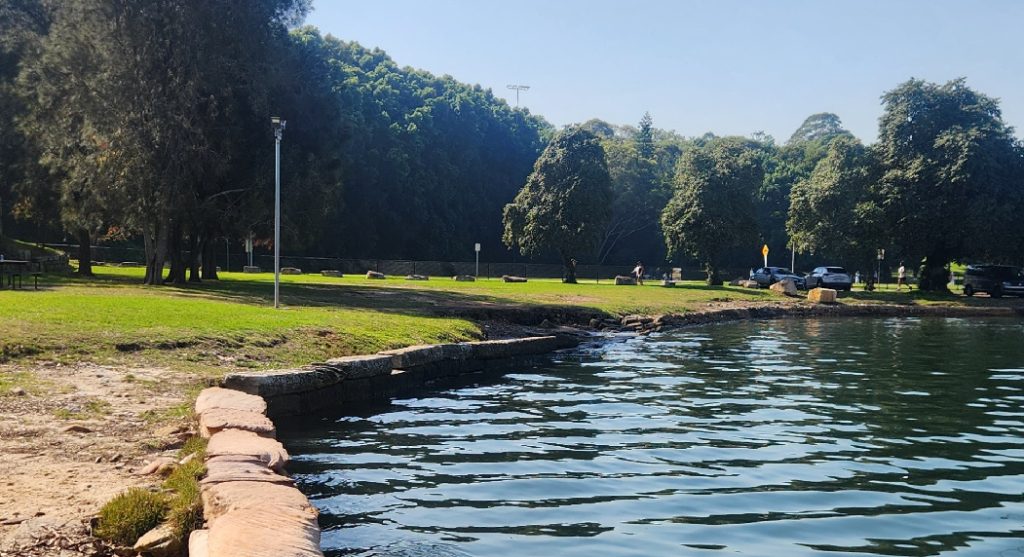
Amenities for the Tidal Baths – a potential eyesore
The reference to a new pavilion inspired by a historic boatshed to ‘support Callan Park Tidal Baths’ is very vague. If such a support actually means an amenities block in this absolute waterfront location on the site of a former wharf, referring to it as a pavilion is very misleading. A pavilion is covered but open sided in design and encourages quiet sitting and viewing of surrounding parklands and waterways. However, an amenities block (which involves enclosed, necessarily private spaces and walls) is not a pavilion. Again, this is inappropriate right on an absolute waterfront site on the western point at Callan Point.
There is already an amenities block a little further west (adjacent to the waterfront sports fields) which could easily be updated or extended if more facilities are required for the baths. And there are more modern amenities just past the canal at Waterfront Green. The last thing needed on this precious piece of waterfront land at Callan Point is a change room and toilet block – right on the water, posing as a ‘pavilion’. Amenities need to be set back from the waterfront, as they are whenever they are provided on any of our beaches or ocean pools.
We note too that any such “amenities block” is currently ruled out by the Callan Park (Special Provisions) Act. Although we are aware that the GSP supports stripping most vital protections out of this Act, this is not yet a fait accompli.
Waterfront Drive sports field
The rejection of the IWC proposal for plastic grass on the Waterfront Drive Oval is to be applauded. It was completely incompatible with the environmental, sustainability and heritage values of Callan Park. This decision should also result in the removal of the proposed terraced seating on the northern side of the sporting field which would detract from the aesthetic features of the fig tree covered slope.
The staggered replacement of the Norfolk Island Hibiscus trees along the foreshore is supported. They should be replaced with indigenous species such as Banksia Integrifolia interspersed with low shrubs and groundcovers as a connective green corridor for wildlife.
Central Green
Wharf Road Carpark and the ‘Temporary’ Car Park proposed for Central Green
Earlier this year, in the NSW parliament. Amanda Cohn MLC, posed the following question to Penny Sharp (Minister for Climate Change, Energy, Environment, Heritage and representing the Minister for Planning and Public Spaces):
‘What is the current status of Stage 2 and Stage 3 of the Landscape Structure Plan?’
Minister Sharp answered that ‘The Wharf Road carpark works will be progressed as part of an upgrade that will be delivered as part of the Bay Run project in 2026.’
This answer indicates the Wharf Road carpark will be provided this year. However, we understand from the GSP that while the Wharf Road carpark is a significant feature of the Draft Foreshore Master Plan, it remains unfunded.
Furthermore, a recent Section 60 Application to the NSW Heritage Council to demolish 9 buildings on ‘Central Green’ promised that the demolitions in this precinct would provide greenspace in that Central area. Yet a few weeks later, this Draft Foreshore Master Plan suggests that instead of green space, the demolished buildings will provide space and hardstand for a “temporary” carpark, because no funds have been provided for the much needed Wharf Road carpark.
In addition, all the roads in and around those demolished buildings will also not be removed for new grassy slopes either – given the Foreshore Plan suggests a “temporary” car park for up to 70 cars is now proposed to replace the demolished buildings in this area, because Wharf Road carpark is not yet funded. How can such a priority project be pushed into the future? Surely the Wharf Road carpark is priority?
This is hard to reconcile. It is universally agreed that the Wharf Road carpark is urgently needed in the foreshore area as this will allow for the removal of cars and car parking and an upgrade to the pedestrian promenade along Waterfront Drive. Given that this is such a critical part of the foreshore plan, and that the Minister Sharp has informed parliament that Wharf Road carpark will be provided in 2026, surely any available funds should be directed to this project as a priority immediately. Putting temporary carparks out of the foreshore precinct on land where significant mid-century wards and other related buildings were apparently to be demolished for open space is misleading, wasteful and unnecessary.
This intention of using the Central Green area in this way in the Draft Foreshore Plan makes a mockery of the s.60 Heritage Application to demolish these important buildings. It now seems the precinct will not become a grassy green slope, but instead, a temporary (which often morphs into a permanent), car park. The Wharf Road carpark needs to be provided upfront in the foreshore precinct as a matter of urgency. This will ensure the public get used to parking arrangements that are more appropriately located for the sporting fields and car routes and way-finding around the park becomes clear from the start. A half-done job is never the right approach, and priorities need to be met. A major priority for Callan Park is establishing the main carpark in the correct peripheral location early on.
Planning and funding
Cultural Heritage Management Plan – some concerns
Why is the development of the Cultural Heritage Management Plan only ever referred to in the Draft Foreshore Plan of Management as a document ‘under development to investigate the removal of low value heritage buildings to support restoration of significant landscapes’? Surely a Cultural Heritage Management Plan should be focussed on investigating the heritage significance of not only landscapes but buildings too (and it should be concerned with far more than just the removal of buildings). It needs to be based on heritage maintenance and assessment of significance of all buildings on site, and the maintenance and restoration of many buildings that are important to the story of Callan Park that need to be retained. Critically, it should also be based on the conservation and management principles outlined in the Burra Charter.
It is interesting that Repatriation Ward B (B497) is labelled ‘heritage significant’ in the Foreshore Plan and is slated for restoration – when it has the same category of heritage significance as the mid-century Hospital Ward buildings and related Stores and other structures that are slated for demolition on the Central Green. The treatment of heritage is critical for the whole of the Callan Park site (which is known for its highly significant state and national heritage listings). A thorough and up-to-date assessment of all buildings and landscapes is required for Callan Park in line with the Burra Charter – before any buildings are demolished – otherwise there is a serious risk of losing important parts of the Callan Park story that should be retained for public use and full knowledge about the site for present and future generations.
Restoration of Repatriation Ward B (B497) for a Soccer clubhouse – and community space?
How is it appropriate to only restore part of this building (for the soccer club use) while claiming a lack of funds means the community meeting area and space that is also planned for this building will not be done (and this section will be ‘closed off’). It would be much more costly to bring in builders and contractors at some (unknown) later time to finally finish the full restoration job. And in the meantime, the wider community misses out, while this public building becomes privatised space for the exclusive use of a soccer club. Surely it is a priority to provide this long-promised community space so the whole community can also have access to a meeting space and share in the use of this public asset.
Inadequate Government Funding of Callan Park
The NSW Government needs to realise that unlike some other GSP parklands such as Centennial Park and Parramatta Park, Callan Park is far from being an established parkland – it was a hospital for 125 years and has been a contested site in transition for the past 30 years – with significant under-investment over this time.
The works outlined in the first precinct plan (for the foreshore) need to be properly and fully funded, to give Callan Park the best start at being a community space that (unlike other GSP parks) includes education and health facilities as well as recreation. Inadequate funding of this Foreshore Plan that forces buildings to only be half restored, and much needed appropriately located carparks to be replaced with temporary poorly located ones, is far from best practice management and planning. It means community uses are delayed, and temporary car parks are placed ad hoc in inappropriate precincts – a long way from sporting fields they are supposed to service rather than simply doing the job properly. In summary the result will be a far-from-ideal start for the new phase of life for this significant greenspace.
Callan Park will be in even higher demand as critical green lungs, as a tranquil retreat from intense densification of residential development in the surrounding suburbs. It will be critical infrastructure for a fast-growing population, and it will be intensely used. This will be even truer if there is no significant new green space in the surrounding suburbs. It is therefore very important to get this significant piece of social infrastructure right, and while much of the Foreshore Plan vision is laudable, the lack of funding of priority areas is a major concern.
We are sure the community is ready to actively support the GSP in putting the case to government to ensure adequate funds for critical projects at Callan Park – to ensure best practice planning on this site that needs to ‘catch up’ to others in in the GSP jurisdiction. Otherwise, it becomes a piecemeal planning approach – which is far from best practice.