The Minns government wants to gut the protections in the Callan Park Act. It dreams of privatising and commercialising Callan Park, to make it pay. And pay it would, if these changes go through. Open space, public access and its moral purpose are at stake.
We’ve scarcely drawn breath after responding to the Christmas Development Applications for the two plastic grass fields in Callan Park. Public submissions closed on Monday February 9. Two days later, the Minns Labor government tabled in parliament major amendments to the Callan Park (Special Provisions) Act that will gut the protections in that Act.
Those protections have proven necessary to prevent state governments selling off and privatising this precious heritage parkland site.
The changes that the Planning Minister Mr Scully proposes, would
- Allow building and development on foreshore open space (currently specifically banned in the Act)
- Drop the commitment to public control from the objects of the Act
- Abolish the commitment to universal public access to open space (currently part of the objects of the Act)
- Allow 50-year leases of buildings and land (basically privatisation) – while abolishing the scrutiny and checks and balances of such leases by parliament that currently exist in the Act.
- Allow commercialisation almost without limits on what activities are allowed in Callan Park (would this be allowed in, say, the Botanical Gardens?)
- Eliminate current limits on building outside the footprints or envelopes of current buildings – it would be possible to build on previous open space (currently ruled out)
- Make it more difficult for mental health and other social welfare NGOs to obtain buildings in Callan Park by abolishing the not-for-profit requirement for tenants (note: the previous Coalition government recognised the social welfare purpose of buildings in Callan Park while allowing for-profit arts and music events) and
- Neuter the Community Trust Boards by depriving of their current power to approve (or not) plans of management for their particular park.
There are three reasons given by the Minister for these changes – which go beyond even the changes recommended by a parliamentary select committee..
The first is ensure visitors can get a latte and a slice of banana bread. (Seriously, it’s in the Minister’s speech introducing the amendments.) This can already be done via a social enterprise – as is done elsewhere. Or alternately, provision of food and refreshments can be exempted from the not-for-profit rule, as is the case already with arts and music events. It doesn’t require wholesale commercialisation.
The second is that Callan Park is not unique enough to have a set of its own special protections. Essentially, it should be treated like any other park.
For starters, this ignores the very different history of Callan Park. It is, historically, an accidental park.
Just a little history shows this. Callan Park was purchased in the 1870s from its private owners to build a new model asylum. In the view of the Inspector-general of Lunacy, Frederick Norton Manning, this new asylum would relieve the dreadful overcrowding at Tarban Creek asylum and showcase the therapeutic approach of the American reformer Thomas Kirkbride. His ideas were essentially that a beautiful natural setting and outdoor work would help in the healing of mental illness. Yes, the subsequent history of the asylum, and then psychiatric hospital, was studded with overcrowding and cruelties and the hospital closed in 2008.
But the community has consistently supported the idea that Callan Park should stay true to the original humane impulse behind its establishment and be home to modern mental health services. That was the origin of the requirement that tenants be not-for-profits. This was “the moral heart” of Callan Park as the former member of Balmain, Jamie Parker, used to put it.
When the Greater Sydney Parklands Trust Act was passed in 2022, Rob Stokes, the then Minister for Planning and Public Places, accepted that Callan Park was to remain a place where NGOs concerned with the most vulnerable and at risk in our society, could secure buildings at non-market rents.
At present, for instance, Life Matters, an RSL-supported charity, is on the threshold of securing a lease on some modern 1990s cottage wards for support services for homeless Veterans. Those wards, incidentally, were an initiative of Peter Collins, the former minister for Health in a Coalition government, and were built after the Coalition abandoned plans to sell off 20% of the site for development.
If the Minister’s proposed amendments go through, NGOs are in danger of being out-bid by for-profit businesses especially as the requirement to pursue financial sustainability would now become an aim of the Callan Park Act.
The third reason for these amendments is to ensure Callan Park raises money – euphemistically dubbed “financial sustainability”. Ironically, the Minister began his speech to parliament by assuring us that parks are “essential public infrastructure”. If that’s the case, and it is, then it’s core government responsibility to ensure they are properly funded.
Of course, the Minister holds out the promise that the funds raised from the privatisation and commercialisation will be used to restore the heritage buildings in Callan Park.
The Minister is misleading in this – possibly out of ignorance, having never (to our knowledge) visited Callan Park. The largest of the heritage buildings in Callan Park – Kirkbride, the suite of sandstone Italianate gothic buildings covering 5 hectares – is already in the midst of a comprehensive renovation. Likewise, other highly significant heritage items have been restored in recent years. Kirkbride also earns money from occasional film and television productions onsite (such as Disney’s The Artful Dodger).
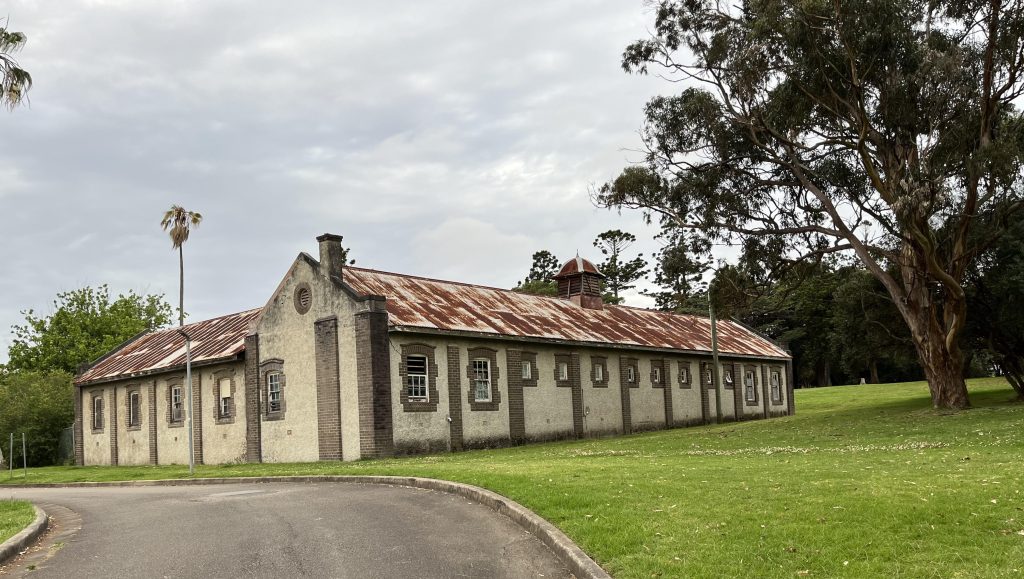
Yes, there are appalling cases of neglect – specifically:
- the convalescent cottages,
- the old stables,
- the dairyman’s cottage and
- Broughton Hall.
All these require urgent protection. Any commercial tenant would have to expend a small fortune – and that is extremely unlikely. Government spending is essential and urgent to save them.
As for the non-heritage buildings on Callan Park, most are slated for demolition under the Landscape Structure Plan. The Minister’s own government allocated $4.6 million in its last budget to continue this process.
Of course, by lifting the restrictions on building on existing open space, the Minister may be hoping for new businesses to develop parts of the parkland.
Conceivably, the big dollars the Minister is dreaming of would come from leasing Kirkbride (which is owned by NSW Health). The Act rules out hotels and function centres and the Minister doesn’t advocate changing that. This leaves possibilities like business parks and private schools occupying Kirkbride. Do we really want that in Callan Park?
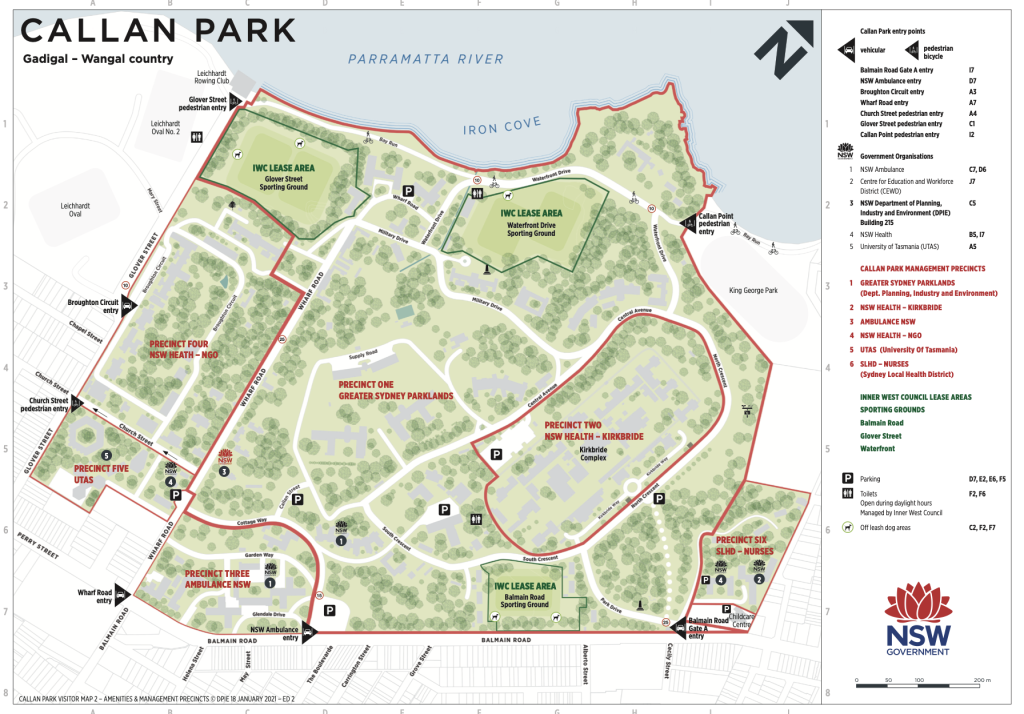
There is the question of the fate of the spread of mid-20th century buildings in the south-west corner of Callan Park (see map below) that still house part of the NSW ambulance services, although those remaining services are slated to move in the near future. The future of this corner does need careful planning. Like Kirkbride it is owned by NSW Health.
Clearly the changes being promoted by the Minister are excessive, illusory or dangerous – and not in the public interest. Two safeguards are left untouched, for the time being. The first is that the consent authority for development will remain the local Council, although it is controlled by the same minority party that controls the state government. Realistically, that protection is largely non-existent. The second is the requirement for approval by the Heritage Council for any development. The jury is currently out on how strong and independent that safeguard is.
There is no escaping the need to stop these changes going through. This Minns “Labor” government is a minority government – and decidedly so in the Upper House of parliament where they control 17 and the 42 seats. Will the Upper House majority roll over and endorse this abandonment of safeguards for what is arguably the most valuable of our country’s heritage parks?