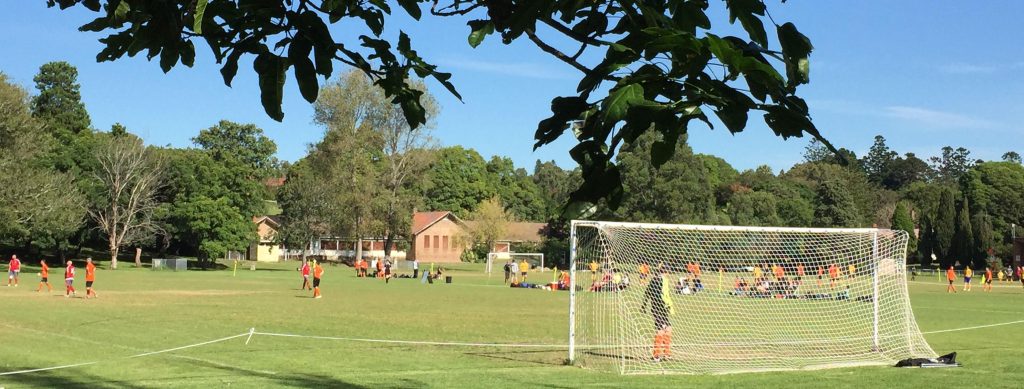
In June the Inner West Local Planning Panel unnimouslly rejected the first attempt to install a plastic grass field on the foreshor of Callan Park. The proposal had drawn 540 written objections from the community – compared to 190 in favour. Despite this, the Inner West Council has now advertised another Development Application for a plastic grass field on Waterfront Drive in Callan Park.
Council’s consultants describe it as basically the same design as the Development Application already refused by the Panel on the grounds of plastic and chemical pollution dangers from flooding. The south-eastern corner of the proposed field has been raised 350mm and the porosity of subsurface drainage gravel increased. The northern end of the adjacent remnant natural grass field would also be raised 350mm.
Whether these changes would prevent the pollution flowing into the Harbour waters when the field is flooded is an open question. That pollution could be a mix of nano- and micro-plastics, PFAS and cleaning chemicals. The field is about 20 metres from the water. This matters because section 6.8 of the State Environmental Planning Policy (biodiversity and conservation) 2021 prohibits development that could pollute the Harbour waters.
The adequacy of the new design will be strongly challenged but all the other drawbacks and dangers of the proposal remain even if the majority on first Panel chose to disregard them.
What follows are some notes on the deleterious impacts that would result from the installation of this field. The Friends are preparing an expanded version for submission.
- Pollution of Sydney Harbour waters
Such fields shed hundreds of kilograms of micro- and nano-plastics each year. The Council and its consultants only seem concerned with capturing the plastic particles that can be washed off the field. As we know from the plastic grass in the adjacent King George V park, plastic particles can be blown off or walked off. The claim that the provision of two or three foot-brush mats will capture the walked-off micro-plastics, and the 15cm high curb around the field the blown-off particles, is stretching things even for the proponent.
- Endangering public health
The Council has commissioned no independent testing for PFAS (or forever chemicals) that are dangerous to human and environmental health. There is rising global concern about the dangers of these chemical compounds – even the NSW government has acted to restrict them after revelations about PFAS entering our water supply.
Yet Council has done no independent testing to ensure the plastic grass fields will be free of these dangerous chemicals which are widely used in the production of plastic products.
In a response to a Councillor, Council, on the one hand, accepts their supplier’s assurance that no hazardous PFAS have been “intentionally” added, and on the other, in the same assurance, that no PFAS “harmful to human health” are in the product. For the latter claim the preferred supplier claims to have “independent tests”. But there is no evidence that Council has sought or verified these supposed tests.
Let’s be clear: There are laboratories that can test for the presence of PFAS but Council has not bothered to use them.
- Adding to mountains of plastic waste
The plastic in these fields has to be replaced every 7-10 years but Council has admitted – in an answer to a Councillor in August – that it has no recycling plan. Nor does the extensive documentation accompanying this DA provide any details of how and where this material will be recycled. Council is proud of its FOGO scheme for compositing garden and food waste and names its contractor and gives their address. No such care for this plastic waste.
- Denying access to dog walkers and cricketers
Cricketers and the public have had access for more than a century and more recently the field has become popular with dog walkers. Now all those users will be banned.
(Incidentally, the Council consultants argue continually that this field will only take about 1 hectare of the 32 hectares of open space at Callan Park. Yet the real comparison is how much of the usable foreshore open space the field will monopolise which is closer to 20%.)
- Reducing the heritage status of Callan Park
The landscape at Callan Park is heritage listed on the State Heritage Register for its “pastoral” nature and “intact design” – plastic fields, encased in concrete, have no place in such a landscape.
The Heritage Council has to green-light this DA before it goes any further. The members of the Council divided 50-50 on the first iteration of this field with the chair using her casting vote to approve the field. This was a surprise as the Approvals committee of the Heritage Council had previously indicated their “preference” for natural turf. Thanks to a FIO application, we now know that in their report to the Heritage Council the staff argued that this “preference” was impractical as the Inner West Council was already using best practice methods for the care of this field and the field was still in bad shape. Yet there was evidence in submissions (the Friends’, for instance) that best practice has not been pursued. This evidence needs to be highlighted and drawn to the attention of the Heritage council members.
- Increasing traffic and parking problems
The projected increased use will mean more traffic and parking – already there are plans for a car park for 70-cars in the middle of the parklands. Greater Sydney Parklands claims it will be “temporary” but simultaneously admit that it is unlikely they will receive the funding in the near future to install the already DA-approved carprk at the end of Wharf Road.
- Damaging the biodiversity of the parklands
Callan Park has been declared a biodiversity sanctuary or refuge in the biodiversity strategy of the Inner West Council but plastic surfaces and extended night-time lighting (till 10pm) will make a mockery of that.
- Burdening the ratepayers
These fields are more expensive to install and will need replacing in 7 to 10 years at a cost $1.5 million, according to Council. Meanwhile the estimated maintenance costs will be the same as for a natural turf field.
- Contributing to climate change
Plastic is a product of the fossil fuel industry. In addition, these fields are heat islands and replace carbon sinks in the form of natural turf .
A major study of these plastic fields described their contribution in the following terms:
the manufacturing process to produce artificial turfs requires large amounts of water, energy, and non-renewable petroleum-based materials (e.g., polyethylene)to make the turf. CO2-emissions from artificial turfs occur during manufacturing, production, transportation, installation, maintenance and at end of life (e.g., incineration of fields) (FIFA 2017).
– International Journal of Environmental Science and Technology (2024) 21:10205–10216
https://doi.org/10.1007/s13762-024-05689-3
Finally it has to be reiterated so that there can be no dispute: No one is against sporting uses of the Waterfront Drive field, but the oval does need best practice care of the natural turf. Council claims that the field gets best practice maintenance but expert opinion contradicts that.
__________________________________________________________________________________________
What you can do
Lodge an objection. Use the QR code for details of the proposal and lodging an objection. You can also email your objection to council@innerwest.nsw.gov.au Subject: Submission to REV/2026/0005
Snail mail submissions should be sent to PO Box 14, Petersham NSW 2049
Please note that submissions close on October 6
______________________________________________________________________________________________
What happens after submissions close?
This new DA will go before the Heritage Council and if – against all heritage concerns – that Council approves it, then it will go before the Inner West Planning Panel for final decision.
___________________________________________________________________________________________________